

; "Click to open image!")
; "Click to open image!")
; "Click to open image!")
; "Click to open image!")
; "Click to open image!")
; "Click to open image!")
; "Click to open image!")
; "Click to open image!")
; "Click to open image!")
; "Click to open image!")

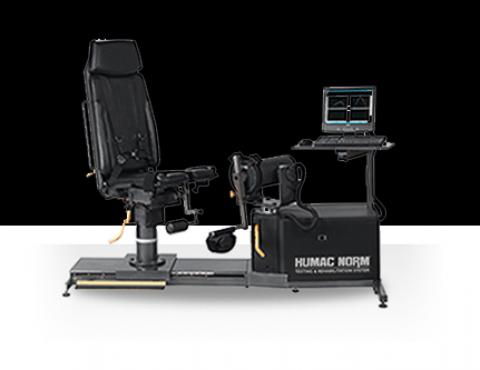
The HUMAC NORM includes attachments to perform 22 isolated patterns covering the shoulder, elbow, wrist, hip, ankle and back. optional attachments allow Trunk extension / flexion, work stimulation and closed kinetic chain patterns.
Humac Norm Defined
-
Intuitive User Interface
-
Context-Sensitive Help System
-
Integrated Computer System
-
Auxillary Outputs (AO)
-
Maximum Resistance
-
Continuous Rotation
-
Adjustable Range of Motion Stops
-
Secure Patient Positioning
-
Movable Chair - Fixed Dynamometer
-
Locking Clamps
|
Mode |
Speeds |
Torque |
|---|---|---|
|
Isokinetic Concentric |
500 per sec |
500 ft-lbs / 678 Nm |
|
Isokinetic Eccentric |
500 per sec |
500 ft-lbs / 678 Nm |
|
CPM |
500 per sec |
500 ft-lbs / 678 Nm |
|
Isometric |
500 ft-lbs / 678 Nm |
|
|
Isotonic |
500 ft-lbs / 678 Nm |
POWER REQUIREMENTS
|
Input Voltage |
220 VAC (other voltages available) |
|---|---|
|
Input Frequency |
60Hz (international frequency 50Hz available) |
|
Independent |
20 amp dedicated circuit required |

Manufacturing
HUMAC NORM Systems are manufactured just outside Boston in Stoughton, Massachusetts, USA. The HUMAC NORM consists of four component groups – metal fabrication, computer, electronics, and software. The manufacturing process is performed under our ISO9001 Certification Process.
Metal fabrication (cut, weld, and paint) is performed by a nearby specialty custom fabrication facility. Computers are supplied by DELL Computers, the world leader in small computer systems. Custom circuit boards are designed in-house and manufactured by a nearby fabrication house. Lastly our HUMAC Software is developed and produced in-house.
The HUMAC NORM components are gathered at our corporate facility for final assembly, testing, and packaging. We ship HUMACs worldwide, with customers throughout the US, Great Britain, and elsewhere.
Regulatory Approvals
- CENELEC EN 60601-1-2 - 2001 - Medical Electrical Equipment Part 1-2: General Requirements for Safety - Collateral Standard: Electromagnetic Compatibility - Requirements and Tests IEC 60601-1-2: 2001.
- CENELEC EN 60601-1 - Medical Electrical Equipment Part 1: General Requirements for Safety Incorporates Corrigendum July 1994; Includes Amendments A1: 1993, A11: 1993, A12: 1993, A2: 1995 and A13: 1996; IEC 601-1: 1988 + A1: 1991 + A2: 1995 + Corrigendum 1995, Modified.
- UL 60601-1 - UL Standard for Safety Medical Electrical Equipment, Part 1: General Requirements for Safety First Edition.
- CSA C22.2 NO 601.1-M90 - Medical Electrical Equipment - Part 1: General Requirements for Safety General Instruction No 1; Supplement 1; 1994 R(1997).
- IEC 60601-1-1 (1992-01) - Medical Electrical Equipment Part 1: General Requirements for Safety 1. Collateral Standard: Safety Requirements for Medical Electrical Systems First Edition.
-
IEC 60601-1 - Medical Electrical Equipment Part 1: General Requirements for Safety Second Edition.
CSMi Quality Certification
- ISO 9001:1994 and ISO 13485:1196 with CMDCAS.

Axis of Rotation:
The instantaneous axis of rotation changes throughout the movement. The compromise axis is medial to the acromion process when the limb is in the neutral position.
Parts Needed:
Elbow/Shoulder Adapter
Footrest
Lumbar Cushion

Axis of Rotation:
The instantaneous axis of rotation changes throughout the movement. The compromise axis is medial to the acromion process when the limb is in the neutral position.
Parts Needed:
Elbow/Shoulder Adapter
Footrest

Axis of Rotation:
The instantaneous axis of rotation changes throughout the movement. The compromise axis is medial to the acromion process when the limb is in 90° horizontal abduction.
Parts Needed:
Elbow/Shoulder Adapter
Footrest
Torso Belt

Axis of Rotation:
The instantaneous axis of rotation changes throughout the movement. The compromise axis is medial to the acromion process when the limb is in 90° horizontal abduction.
Parts Needed:
Elbow/Shoulder Adapter
Footrest
Torso Belt

Axis of Rotation:
The axis of rotation is the longitudinal axis of the humerus.
Parts Needed:
Wrist/Shoulder Adapter
Elbow Stabilizer Pad

Axis of Rotation:
The axis of rotation is the longitudinal axis of the humerus.
Parts Needed:
Wrist/Shoulder Adapter
Elbow Stabilizer Pad
Lumbar Cushion

Axis of Rotation:
The axis of rotation is the longitudinal axis of the humerus. If length adjustment of wrist / shoulder adapter is correct, and elbow flexed at 90° with forearm parallel to input arm, the axis alignment will be established and maintained by the Elbow Stabilization Pad.
Parts Needed:
Wrist/Shoulder Adapter
Elbow Stabilizer Pad

Axis of Rotation:
The instantaneous axis of rotation changes throughout the movement. The compromise axis is medial to the acromion process when the limb is in the neutral position. The motion for this pattern begins in full Extension-Abduction and moves to full Flexion-Adduction, the limb should be supinated and externally rotated.
Parts Needed:
Elbow/Shoulder
Adapter Footrest

Axis of Rotation:
The axis of rotation is immediately distal to the lateral epicondyle and moves only slightly anteriorly as flexion increases.
Parts Needed:
Elbow/Shoulder Adapter
Footrest
Lumbar Cushion

Axis of Rotation:
The axis of rotation bisects the head of the ulna distally and the head of the radius proximally. It is established by placing the forearm directly in line with the dot on the dynamometer input tube at approximately the level of the ring finger.
Parts Needed:
Thigh/Forearm Stabilizer Tube
Forearm Stabilizer V-Pad
Wrist/Shoulder Adapter
Lumbar Cushion
Counterbalance Weight

Axis of Rotation:
This axis alignment is critical and somewhat difficult in the pattern. The axis of rotation is slightly oblique passing through the wrist just distal to the tubercle of the radius and the head of the ulna (approximately where the hand meets the wrist).
Parts Needed:
Thigh/Forearm Stabilizer Tube
Forearm Stabilizer V-pad
Wrist/Shoulder Adapter
Lumbar Cushion

Axis of Rotation:
The axis of rotation is located approximately at the center of the capitate bone. This is found at the middle of the wrist just distal to the axis for extension/flexion.
Parts Needed:
Thigh/Forearm Stabilizer Tube
Forearm Stabilizer V-pad
Wrist/Shoulder Adapter
Lumbar Cushion

Axis of Rotation:
The axis of rotation is superior and medial to the greater trochanter.
Parts Needed:
Knee/Hip Adapter
Knee/Hip Pad

Axis of Rotation:
The axis of rotation is slightly anterior in extreme flexion as the pelvis tilts to increase range of motion. The normal movement synergy does not affect testing accuracy.
Parts Needed:
Knee/Hip Adapter
Knee/Hip Pad
Footrest

Axis of Rotation:
The axis of rotation is a mechanical axis of the femur (line through centers of hip and knee joints). This can be visualized, approximated and then fine adjusted during warm up/familiarization repetitions.
Parts Needed:
Ankle Adapter
Footplate
Footrest

Axis of Rotation:
The most accurate fixed axis for rehab or testing of the knee is a line passing transversely through the femoral condyles.
Parts Needed:
Contralateral Limb Stabilizer
Knee/Hip Adapter
Knee/Hip Pad
Lumbar Cushion

Axis of Rotation:
The most accurate fixed axis for rehab or testing of the knee is a line passing transversely through the femoral condyles.
Parts Needed:
Knee/Hip Adapter
Knee/Hip Pad

Axis of Rotation:
The axis of rotation is slightly medial to the longitudinal axis of the tibia. This can be visualized, approximated and then fine adjusted during warm up/familiarization repetitions.
Parts Needed:
Ankle Adapter
Footplate
Thigh Stabilizer Pad
Thigh/Forearm Stabilizer Tube
Footres

Axis of Rotation:
The axis of rotation passes obliquely (approximately 16° anteromedially) through the tip of the fibula (lateral malleous) and the trochlea of the talus, exiting just distal to the tip of the tibia (medial malleous).
Parts Needed:
Ankle Adapter
Footplate

Axis of Rotation:
The axis of rotation passes obliquely (approximately 16° anteromedially) through the tip of the fibula (lateral malleous) and the trochlea of the talus, exiting just distal to the tip of the tibia (medial malleous).
Parts Needed:
Ankle Adapter
Footplate
Footrest
Thigh Stabilizer Pad
Thigh/Forearm Stabilizer
Counterbalance Weight

Axis of Rotation:
The axis is compound and changes throughout range of motion of the talo-crural joint, talocalcaneal joint and talonavicular/ calcanecuboid or transverse tarsal joint.
Parts Needed:
Ankle Adapter
Footplate
Thigh Stabilizer Pad
Thigh/Forearm Stabilizer Tube
Footrest